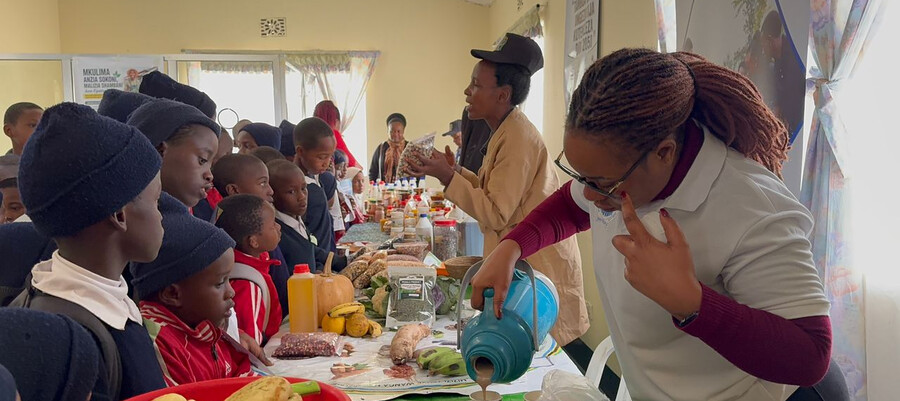
The 2nd East African Conference on Agroecology allowed for 3 days of discussion on progress in the fields, and in terms of public policies.
The conference brought together around 800 participants, representing civil society organisations, farmers’ organisations, small businesses, research institutes, donors, development partners, local authorities and governments. Over 30 countries were represented, with a majority of organisations from East Africa, but also from other regions of Africa (Senegal, Democratic Republic of Congo), Asia (India), Europe and North America.
There is a definite dynamism in East Africa on agroecology, with a diversity of stakeholders involved in a variety of activities (promotion of agroecology among farmers, research work, creation of value chains and certification, agroecological businesses, local to national advocacy initiatives, etc.) Kenya, Tanzania, Uganda and Zambia have adopted national agroecology strategies.
Discussions during the plenary sessions and parallel workshops highlighted the following stakes for the sub-region:
- Recognition and protection of farmers’ seeds as a basis for the agroecological transition and for the resilience of farming systems.
- The need to create remunerative local market opportunities for agroecological products and to stimulate local demand for healthy products.
- Support for women and young people, as an enabler for agroecological transition.
- The need for tools to monitor and evaluate agroecological performance: to bring evidence informing political decision-making and to monitor the implementation of national strategies.
The conference resulted in a declaration, including over twenty recommendations regarding scientific research, the mobilisation of public authorities, financing, trade and private commitments.
The participation to the conference allowed CARI to meet and get to know East African organizations and networks, and to invite them to contribute to the Désertif’actions program. As a result, PELUM Kenya, the Indigenous Women and Girls Initiative, and the Chemichemi Foundation started their collaboration to organize a Désertif’actions National workshop in Kenya.
Part of the discussions during the Conference also highlighted the continuous need to raise evidence on agroecology impacts and the need for tools to analyse the contribution of farms and organizations to agroecology. This discussion topic gave way to the presentation of various assessment tools:
CGRIAR’s HOLPA assessment tool
As part of its Agroecology Initiative, CGIAR developed the Holistic Assessment Framework (HOLPA) for generating evidence on the agronomic, environmental, social and economic performance of farm households as well as agricultural landscapes at various stages of the agroecological transition.
The tool was developed mobilizing the Agroecological Living Landscape (ALL) in 8 countries (Burkina Faso, India, Kenya, Lao, Peru, Senegal, Tunisia).
The HOLPA framework consists of three components:
- a context module that describes the socio-ecological context of the farm household or landscape,
- an agroecology module that considers the level of integration of the 13 agroecology principles
- a performance module for assessing holistic outcomes: including global key performance indicators (allowing cross-sites comparison) and context-specific indicators identified and selected by local stakeholders.
The Agroecology Finance Assessment Tool, presented by the Agroecology Coalition
This tool was developed by the Agroecology Coalition to document the evolution of investments in agroecology. It also provides a guide for the development of project proposals.
The tool is based on the HLPE 13 principles and FAO 10 elements. It aims to assess donors’ portfolio of projects.
The evaluation is run through a 2-steps process:
- Identification of red-flags (if a red-flag is identified, it is not possible to proceed to the 2nd step)
- Assessment based on the 13 principles.
More about the Agroecology Finance Assessment Tool
The Business Agroecology Criteria Tool (B-ACT), presented by Biovision Foundation
This tool assesses the alignment of enterprises with the 13 HLPE principles.
Biovision defines an agroecological enterprise as a business which aligns with the 13 principles of agroecology, creating environmental and social impacts.
The assessment process also starts with identifying the red flags (screening questions) like introduction of GMOs, promote use of synthetic fertilizers and pesticides, promote extensive single cash productions, …
Then the 2nd phase is a questionnaire based on the 13 principles.
The tool is very accessible and does not assess impacts of the business. It shows the intentions of the business and how they align with agroecology.