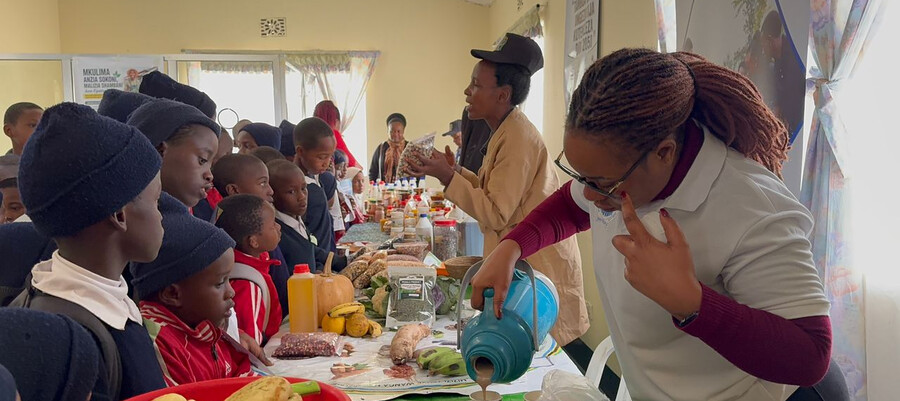
Since 2022, the project has supported the agroecological transition of more than 1,400 small-holder farms. Training activities in production techniques, marketing support and nutrition awareness have directly benefited 1,043 women farmers who are members of farmer groups set up in the villages where the project is being implemented.
A project for women’s participation
From the begining, the project’s interventions were purposively designed to ensure significant participation by women. Farmers’ groups had to be composed of at least 50% women to benefit from the project’s support.
The groups were then consulted to choose the techniques and new practices on which their members wished to receive support. This made it possible to consider the specific needs of women and integrate them into the training programmes. For example, the introduction of poultry farming corresponded to the interests and existing knowledge of the women.
Other aspects were considered to encourage the active participation of women in the farmer groups throughout the project: project facilitators visited each village regularly to organise training and experience-sharing activities within the groups, reducing travel challenges. In addition, the schedules for meetings and training sessions were adapted to the domestic responsibilities of the women.
Throughout the project, the achievement of tangible results also encouraged women to remain involved. They saw the benefits of the practices introduced by the project, such as improved water management, increased yields, diversified diets, and even higher incomes from the sale of products such as vegetables, eggs and chickens.
This project strategy was effective in encouraging women to join the groups and supporting their active participation not only in production activities but also in leadership roles within the group. The intention was to ensure women are meaningfully involved in decision making processes within the groups.
At the end of the first phase of the project (2022-2025), the farmers’ groups that had been set up were composed of an average of 70% women, exceeding the initial ambitions. Of the 63 group leaders appointed by their peers, 31 are women.
This significant participation by women is also encouraged by the socio-cultural context: women already play a central role in small-scale agriculture and household food security. They are keepers of traditional farming knowledge, seed saving, and nutritional decisions within households. These existing roles made it culturally acceptable and even easy to continue engaging with Kilimo Endelevu project activities
It is therefore the fusion between the approach implemented by the project and the socio-cultural context that has enabled women to become involved in the project’s activities. It is interesting to note that most men, even those who did not participate in group activities, support their wives because they see the value of the project.
The Kilimo Endelevu Arusha project
The Kilimo Endelevu Arusha 2022-2025 project is the 1st phase of a 9-year program whose aim is to contribute to the resilience of the populations of the Arusha region in Tanzania in the face of climatic and environmental disruption, through support for family farms to ensure their sustainability and increased contribution to the area’s food and nutritional sovereignty.
This project is the fruit of a partnership between the CARI association, the Belgian NGO Iles de Paix, the Tanzanian NGO RECODA and the farmers’ organization MVIWAARUSHA. To achieve their objective, the partners act simultaneously on several links in the food system: at plot and territorial level, from production to consumption, and with the diversity of actors playing a role in the food system.
The Kilimo Endelevu Arusha project is supported by the French Development Agency (AFD), the Belgian Cooperation (DGD), the MIROVA Foundation and the Occitanie Region.