On 27 June, a closing workshop was held for the “Oasis women, builders of development and creators of value” (PROFOB) project, implemented in the communes of Atar and Tawaz (Adrar, Mauritania) by the NGO Tenmiya, CARI and the El Velah association, with funding from the European Union.
The aim of this 3-year project was to promote the social and economic emancipation of oasis women through an integrated approach combining capacity-building, the structuring of women’s cooperatives, support for micro-enterprises and inclusion in local governance.
A look back at the closing workshop
The event was attended by 85 participants, the majority of whom were women (68) from the cooperatives benefiting from the project, as well as representatives of the administrative authorities, devolved technical services, implementing partners and members of local civil society.
The main aim of the workshop was to draw up a participatory assessment of the results achieved by the project, to present the concrete initiatives that have come into being thanks to the technical and financial support, and to discuss ways of sustaining these actions beyond the current funding. It was also an opportunity to highlight the efforts made by women in local value chains, to hear first-hand accounts of the transformations they have undergone individually and collectively, and to mobilise stakeholders to maintain the momentum.
This high point of the project was an opportunity to review the main results and lessons learnt from the project, including the following:
- The direct involvement of more than 600 local women in the project, whether farmers, processors, craftswomen or people with economic initiatives. Among them, 39 women’s cooperatives have benefited from personalised support, particularly in terms of internal organisation, collective management and participative governance. At the same time, 10 individual women entrepreneurs received technical and financial support to help them structure their business, manage their accounts, market their products and access microcredit.
- The organisation of two regional fairs, in Atar and Tawaz, enabling dozens of women to sell their products, make business contacts and strengthen their position on the local market. The second fair, held the day before the closing workshop, attracted more than 120 visitors and 38 exhibitors, and is a striking example of this dynamic.
- A gender-focused participatory diagnosis was carried out, leading to the creation of a toolkit aimed at better integrating gender issues into local policies, for use by partner municipalities. The toolkit contains practical information sheets, training modules and monitoring tools to promote the equitable participation of women in decision-making bodies.
- Raising awareness of local governance issues among 120 women, 40 of whom received specific training in community leadership, enabling some of them to take on a more active role in their cooperatives or on community development committees.
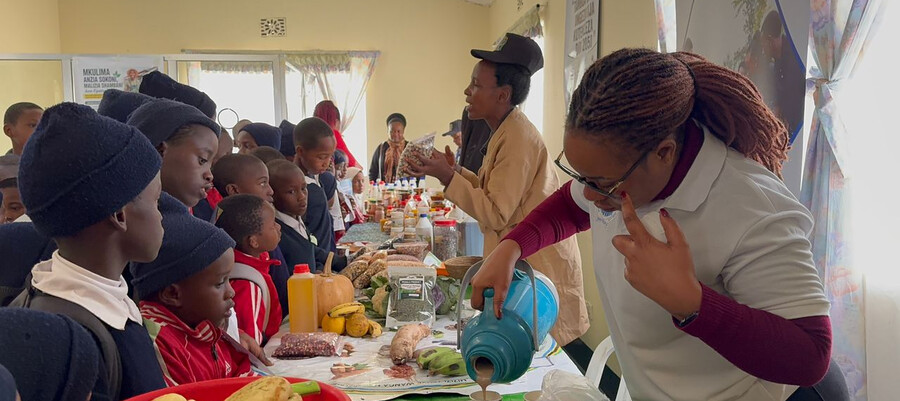
At the end of the closing workshop, there was time for a friendly, informal exchange, and all the participants were invited to visit the oasis women’s fair, held in the adjoining courtyard. The visit was an opportunity to showcase the work carried out by the women supported under the PROFOB project.
The stands, carefully set out by the cooperatives and individual entrepreneurs, offered a wide variety of products from oasis agriculture and artisanal processing: packaged dates, bissap syrups, tomato or carrot jams, beauty products made from local ingredients, traditional fabrics and handicrafts. The participants also expressed their pride at being able to showcase their skills publicly, and their desire to make this type of event a permanent feature of their local economy and society.
Attended by officials such as the deputy mayor of Atar and the deputy Wali of Adrar, as well as representatives of civil society and decentralised services, the workshop not only raised the project’s profile with regional institutions, but also created a forum for listening and dialogue between stakeholders on the future needs of oasis women, with a view to sustainable, inclusive and locally-based development.